




1 hour ago
Fulton Sheen on Firing Line: The Archbishop Who Couldn’t Defend the Church from Its Own Revolution
William F. Buckley challenged the collapse of Catholic discipline and tradition.
Sheen responded with horoscopes, “theological capitalism,” and a remarkable amount of patience for heresy.
Chris Jackson via Hiraeth in Exile [Slightly adapted] | Nov 22, 2026
On January 6, 1970, William F. Buckley Jr. invited Archbishop Fulton J. Sheen onto Firing Line to discuss skepticism and disorder.
The result was an extraordinary television interview, though probably for reasons neither man intended.
Buckley, a layman, repeatedly pressed the famous archbishop to explain why the Catholic Church appeared increasingly reluctant to defend its own doctrines, discipline its dissenters, or preserve the distinctive religious identity that had attracted converts for centuries.
Sheen was supposed to be the Catholic authority in the room.
Instead, the greatest television preacher of his generation spent much of the interview explaining why the Church had become more accommodating, why the changes associated with Vatican II needed additional time, and why the supposedly rigid habits of the past had given way to a more compassionate relationship with the world.
Then Buckley asked about someone who denied the divinity of Jesus Christ.
Sheen’s answer deserves particular attention.
The Archbishop Who Wouldn’t Excommunicate Heresy
The exchange begins around the thirty-first minute.
Buckley raises the astonishing reluctance of the postconciliar hierarchy to discipline Catholic dissenters. He specifically names the National Catholic Reporter, whose editorial direction had become an embarrassment to Catholics still interested in orthodoxy. A moment later, he invokes the excommunication of the Modernist George Tyrrell, contrasting Tyrrell’s offenses with the doctrinal deviations appearing regularly in Commonweal. His point is devastating: the Church once disciplined men for teachings that its own Catholic publications could now circulate with apparent impunity.
Why, Buckley wants to know, does the Church tolerate people who openly repudiate its fundamental teachings?
Sheen responds with the parable of the wheat and the cockle. Christ, he explains, permits both to grow until the harvest.
A familiar passage. Unfortunately, it answers a different question.
Buckley is asking about ecclesiastical discipline. Sheen replies as though the only alternatives were universal toleration or an immediate attempt to purge every sinner from the Church.
The Catholic Church had spent nearly two thousand years distinguishing sinners from heretics, private faults from public offenses, and the correction of souls from the protection of the faithful. Apparently, all that was rather difficult to fit into a television answer about being nice.
Buckley persists.
He points out that excommunication had historically served a purpose, including the defense of the Church’s integrity. Why was it now so rarely invoked against public repudiations of Catholic teaching?
Sheen explains that the Church has become more patient and kind. He celebrates the movement away from the former rigidity of excommunication toward patiently bearing offenses.
Then comes the extraordinary exchange, at approximately 38 minutes.
Buckley asks whether someone who declares that he cannot believe in Christ’s divinity has committed an excommunicable offense.
Sheen replies that the Church would not excommunicate a man merely for making that statement. The proposition would be false, he acknowledges, but he denies that it would be excommunicable.
There is a rather significant difficulty here.
The law of the Catholic Church in January 1970 said otherwise.
Canon 1325 §2 of the 1917 Code defined a heretic as a baptized person who, retaining the Christian name, obstinately denied or doubted a truth to be believed with divine and Catholic faith.
Canon 2314 §1 prescribed:
“Omnes a christiana fide apostatae et omnes et singuli haeretici aut schismatici ... Incurrunt ipso facto excommunicationem.”
In English: all apostates from the Christian faith, and all heretics and schismatics, incur excommunication by the law itself.
Naturally, the canonical determination requires the relevant conditions. An involuntary doubt, an ignorant question, and an obstinate repudiation of revealed doctrine are different things. The law cannot be applied mechanically without examining the person’s circumstances.
But that is precisely the distinction Sheen should have explained.
A baptized Catholic’s obstinate denial of the divinity of Christ is among the clearest conceivable examples of doctrinal heresy. The applicable law remained in force. Vatican II had not repealed it.
Buckley had handed America’s most celebrated Catholic preacher an opportunity to explain why the Church must defend the divinity of her Founder.
Sheen reached for the language of tolerance.
It is difficult to imagine a more revealing illustration of the postconciliar mentality.
The Great Vatican II Excuse Factory
Several minutes earlier, Buckley had asked a question that should have interested every bishop responsible for the souls of Catholics in 1970.
Church attendance was falling.
Buckley cited figures suggesting that the proportion of Americans attending religious services had declined and that the Catholic decrease was particularly striking.
He wondered whether the erosion might have something to do with Vatican II’s ecumenical enthusiasm and the apparent weakening of Catholic dogmatic constancy.
An excellent question.
For generations, Catholic converts had been attracted by precisely what distinguished the Church from Protestantism: doctrinal certainty, continuity, sacramental authority, and the conviction that the Church taught truths received from Christ.
If those distinctions were being obscured, might Catholics themselves begin to wonder why belonging to the Church mattered?
Sheen rejected the suggested connection.
The culprit, he proposed, was largely the spirit of the age.
Then he began talking about astrology.
He observed that Americans had developed an extraordinary appetite for horoscopes. Belief had hardly disappeared, he suggested. It had migrated into superstition.
All very interesting. It might even have made a respectable sermon about modern credulity.
But Buckley had asked why Catholics were abandoning Catholic worship after an ecclesiastical revolution.
The popularity of newspaper horoscopes did remarkably little to explain why the Church’s own members were increasingly absent from its pews.
Buckley tried again, directing the conversation toward the loss of dogmatic constancy.
This produced one of the strangest theological explanations of the entire broadcast.
Sheen suggested that Christianity had formerly exercised something resembling a monopoly concerning God and the supernatural. The Church, he argued, had maintained too rigid a separation between the supernatural and natural orders, leaving political and social life to invent alternative ideologies.
He characterized the resulting difficulty with the unforgettable expression:
“Monopolistic theological capitalism.”
There it is.
For centuries, apparently, the Catholic Church had been operating an excessively restrictive supernatural franchise.
The trouble was that it claimed a privileged relationship with divine revelation.
One almost expects Sheen to recommend an antitrust investigation against the Council of Trent.
The absurdity lies in the historical theology being offered.
The Church’s claim to possess the fullness of revealed truth was never a commercial privilege arrogated to itself. It was understood as a commission received from Jesus Christ.
Moreover, the traditional Church had hardly abandoned the natural and political orders. Scholastic moral theology, natural law, Catholic social teaching, and the doctrine of Christ’s Social Kingship all addressed man’s earthly obligations.
Leo XIII’s Immortale Dei distinguished the supernatural end of the Church from the temporal responsibilities of civil government while insisting that both orders remain subject to divine law.
Pius XI’s Quas Primas extended Christ’s kingship to families, societies, and nations.
Sheen’s historical picture of a Church that monopolized the supernatural while leaving the natural world to fend for itself bears little resemblance to that tradition.
There was also a rather inconvenient encyclical published in 1928.
In Mortalium Animos, Pius XI rejected religious unity constructed upon the assumption that contradictory religious doctrines could be reconciled through mutual accommodation. The Pope explained that Christian unity depends upon one teaching authority and one faith.
This was Catholic ecclesiology before the postconciliar enthusiasm for dialogue became an organizing principle of religious life.
Even Vatican II’s own decree Unitatis Redintegratio warned against false irenicism that obscures the purity of Catholic doctrine.
Sheen’s answer conspicuously failed to explain where legitimate engagement with the world ended and surrender of the Church’s distinctive claims began.
Buckley was asking about the survival of Catholic identity.
The archbishop was diagnosing an old theological monopoly.
Ninety-Seven Bishops Disappear from Vatican I
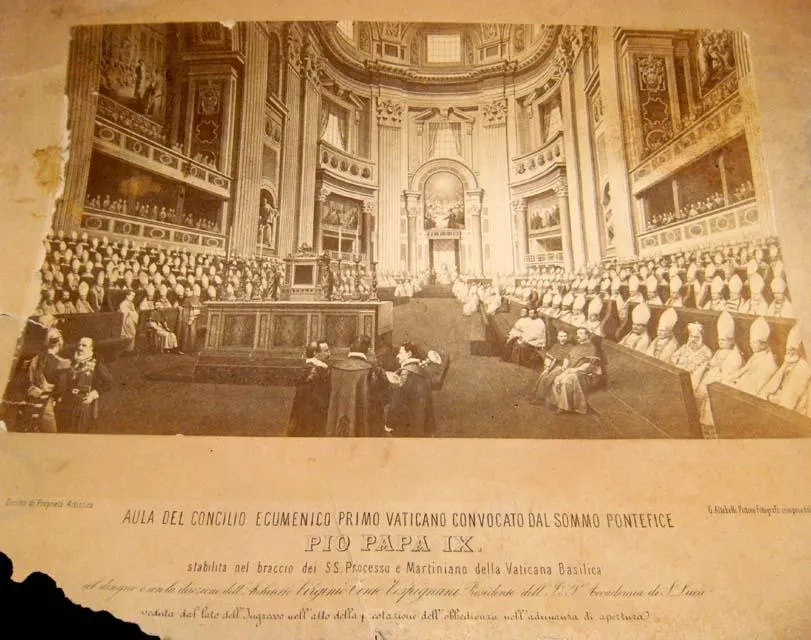
The performance becomes still more astonishing when Sheen attempts to prove that Vatican II had made the Church more genuinely universal.
Around the thirty-seventh minute, he asserts that Vatican I had no bishops from Asia or Africa, whereas the Second Vatican Council included an enormous proportion of representatives from outside Europe.
The broader growth of the Catholic hierarchy across the world was real.
His claim about Vatican I was false.
A contemporary account published in The Catholic World in 1870 listed the council’s participating prelates by geographical region.
It counted 83 from Asia and 14 from Africa.
Ninety-seven bishops.
All apparently misplaced by the archbishop’s recollection.
Many nineteenth-century missionary bishops were European-born, and the development of indigenous hierarchies was an important historical change. That would have been a legitimate subject to discuss.
Sheen, however, declared that there had been no bishops from those continents.
The remarkable thing is that this statistical excursion was offered as an answer to Buckley’s concern about declining Catholic practice.
Even if Vatican II had assembled every bishop on earth, its geographical diversity would have established nothing about the orthodoxy or pastoral effectiveness of its innovations.
A council’s catholicity cannot be measured by counting continents while ignoring doctrine.
The Students Demand a More Agreeable Church
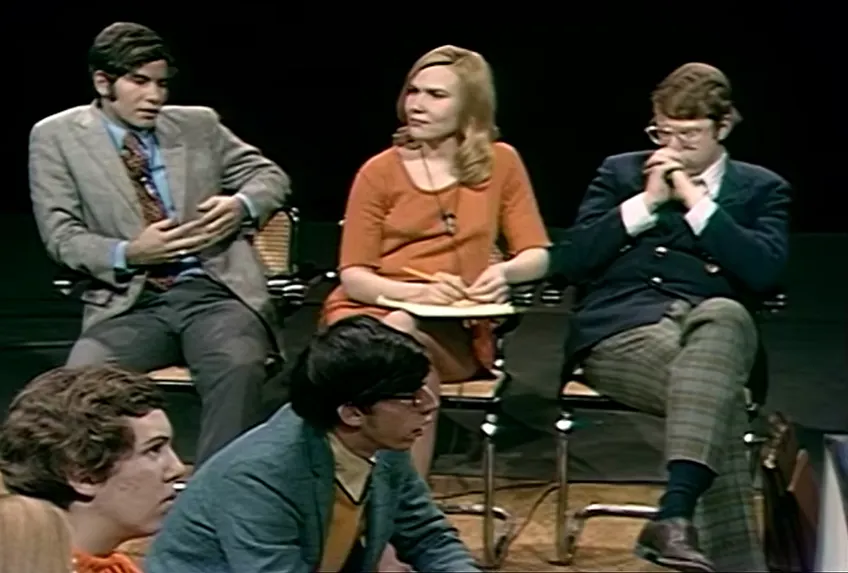
Eventually, the broadcast turns to questions from younger participants.
Here the atmosphere changes.
Buckley had been pressing the archbishop on dogmatic continuity, ecclesiastical authority, and the moral obligations of Christian society.
The younger questioners seem considerably more concerned with whether the Church is sufficiently accommodating to modern sensibilities.
One young woman wonders whether the lack of community in parish worship helps explain declining attendance.
She compares the communal attraction of religious gatherings with the atmosphere surrounding football games and rock concerts.
A fascinating theory of Catholic worship.
Perhaps the parish should install a scoreboard.
The question is revealing because the Mass is being approached principally as a social experience. The underlying concern is whether worship provides enough communal excitement to compete with contemporary entertainments.
Sheen responds by speaking about the need to maintain a balance between individual and community.
Here, to his credit, he does warn against allowing communal enthusiasm to absorb the individual completely. The salvation of one’s soul still matters.
But the theological center of the discussion remains conspicuously absent.
The Mass is the sacramental offering of Christ’s sacrifice. Its essential purpose is divine worship.
Pius XII had explained this at length in Mediator Dei, published only twenty-three years before the interview.
A Catholic parish cannot be evaluated principally by whether its Sunday congregation experiences the excitement of a football crowd.
The question should have provided a splendid opportunity to explain what makes Catholic worship supernatural.
Instead, the television audience received an extended meditation upon the individual and the community.
Another student raises the urban crisis and asks whether the Church ought to surrender certain tax advantages associated with property holdings.
Sheen supplies a detailed account of charitable housing initiatives and distinguishes religious property from holdings that might reasonably be subject to taxation.
The subject itself is legitimate. Catholic institutions have real obligations concerning the proper use of their property.
Still, the sequence is striking.
Buckley has spent half the program worrying about doctrinal disintegration. The student panel has moved on to urban land taxation and whether parishes are sufficiently sociable.
Then comes the question that captures the spirit of the period.
A young questioner complains about pastors who still preach against dancing and insist that girls should remain at home.
Such priests, the student suggests, are alienating the youth. What can be done before the slow process of postconciliar reform drives still more young people away?
Apparently, Catholicism’s immediate pastoral emergency involved the shortage of episcopally approved dancing.
Sheen is reassuring.
He says that he knows very few priests opposed to dancing and agrees that changes should occur. He cautions that lasting changes require time, offering analogies about a child growing into adulthood and the modern appetite for instant results.
He seems delighted to assure the young questioner that the Church is moving beyond the allegedly antiquated restrictions of the past.
The problem is that the student has bundled two different questions together.
A particular pastor’s prudential restrictions on dancing can be debated.
Catholic teaching concerning the duties of husbands, wives, mothers, and fathers rests upon something substantially more serious than a local priest’s social preferences.
Pius XI’s Casti Connubii explicitly defended the order of Christian marriage, the responsibilities of spouses, and the dignity of motherhood against modern attempts to dissolve the structure of family life.
That teaching cannot be dismissed by treating every traditional expectation as a pastoral embarrassment left over from a less enlightened age.
Sheen could have explained the distinction between legitimate prudential customs and enduring moral obligations.
He chose to discuss the speed of change.
And that, more than the silliness of the student’s complaint, reveals the real problem.
The young people were demanding adaptation. The archbishop seemed primarily interested in assuring them that adaptation was underway.
The Folk Mass, the Jazz Mass, and the Missing Sacrifice
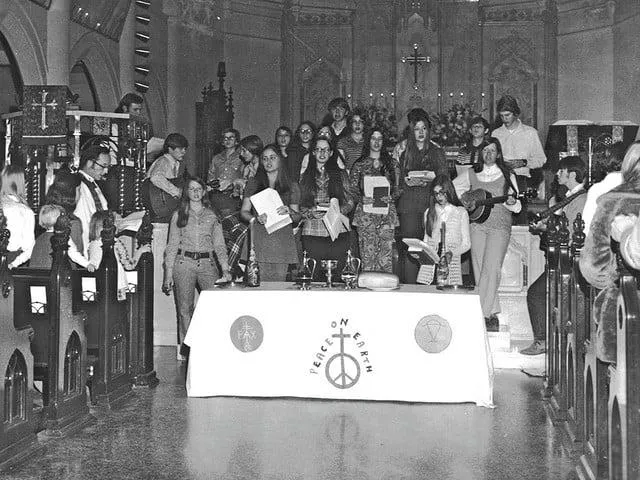
A period image of a guitar-accompanied “Hootenanny Mass,” with young participants gathered around the altar.
The final student question is actually more perceptive.
The questioner observes that experiments such as folk Masses and jazz Masses appear to be losing their appeal. Perhaps tradition, after all, possesses a spiritual importance that these fashionable liturgical innovations cannot reproduce.
The question comes at a remarkable historical moment.
The new Order of Mass associated with Paul VI had only recently entered implementation, beginning on November 30, 1969. Sheen’s interview was recorded just over five weeks later.
Already, arguments over liturgical change were becoming acute.
In September 1969, Cardinals Alfredo Ottaviani and Antonio Bacci had transmitted a critical theological study of the new Mass to Paul VI, alleging serious departures from the inherited theology of the Roman rite.
The student, meanwhile, has noticed something rather more elementary.
The fashionable musical experiments are wearing thin.
Sheen’s response acknowledges the importance of tradition. He compares it to memory, without which a person or institution loses continuity with its own past.
That is one of his better observations.
But once again, he retreats into the familiar language of balance. The Church must preserve both the old and the new.
What he never seriously addresses is the theological criterion by which a liturgical innovation ought to be judged.
Does it preserve the Catholic doctrine of sacrifice?
Does it communicate the sacred character of worship?
Does it faithfully transmit the Church’s inherited liturgical theology?
Those questions had occupied the Council of Trent and Pius XII. The traditional liturgy was never simply an attractive collection of old habits maintained for the emotional satisfaction of people who disliked novelty.
Sheen’s description of tradition as memory captures something important, but leaves the central question unanswered.
A religious institution can remember its past while actively dismantling what that past was supposed to preserve.
The Church required more than a tasteful mixture of antiquity and innovation.
It required fidelity.
The Anti-Communist Who Wanted America to Walk Away from Vietnam
There was once a Fulton Sheen who understood Communism rather well.
In the 1950s, he had made himself famous exposing the atheistic brutality of Marxism-Leninism. He denounced Stalin, explained the philosophical foundations of Communist tyranny, and warned Americans against the comfortable illusion that the Soviet Union was simply another political system.
By January 1970, however, the archbishop was sitting opposite William F. Buckley defending the idea that America could have served humanity by withdrawing from Vietnam.
This was hardly a position Sheen had arrived at accidentally. In August 1967, he had publicly appealed to President Johnson to withdraw American forces immediately, presenting withdrawal as a Christian gesture of reconciliation.
Buckley knew this history.
He also knew that Communist rule had already driven hundreds of thousands of Vietnamese Catholics from their homes in the North. The refugees had fled south after the 1954 partition, seeking refuge from precisely the ideological regime Sheen had spent decades condemning.
Now Buckley wanted to know what Christian responsibility America possessed toward people facing that same danger.
Sheen began talking about restraint.
He praised America’s refusal to unleash its full military power. He discussed the enormous economic burden of warfare, the superiority of humanitarian assistance, and the possibility that withdrawal might provide the world with a moral example.
At approximately sixteen minutes, Sheen acknowledges that his earlier position had lost some of its practical force. In 1967, he thought withdrawal could have earned the world’s moral approval. Three years later, he admits, leaving Vietnam would expose America to the accusation that it had lost its first war.
An extraordinary admission.
His earlier proposal apparently depended in considerable part upon the international admiration America might receive for abandoning the conflict.
Buckley then raises the question of persecuted Christians in Communist China and North Vietnam. Could humanitarian generosity and dialogue really substitute for defending populations threatened by aggressive regimes?
Sheen suggests spending more money helping the oppressed rather than on armaments.
But how was such assistance supposed to protect Catholics living under Communist governments determined to suppress their religion? Foreign aid cannot simply be substituted for political freedom, particularly where the authorities themselves control access to the population.
The subsequent history supplies a grim perspective. After the Communist victory in 1975, South Vietnam experienced political imprisonment, reeducation camps, religious repression, and a massive refugee exodus.
That outcome alone cannot settle the prudential debate about American military strategy. It does establish that Buckley’s concern for the people who would fall under Communist rule was painfully concrete.
The irony is that the famous anti-Communist bishop had spent decades warning Americans about the character of the Communist state. When Buckley confronted him with the consequences of Communist victory in Vietnam, Sheen’s answer had become an appeal for restraint and reconciliation.
The old Fulton Sheen knew the enemy.
The Fulton Sheen of 1970 seemed strangely reluctant to discuss what would happen to the enemy’s victims.
The Fulton Sheen Who Knew Better
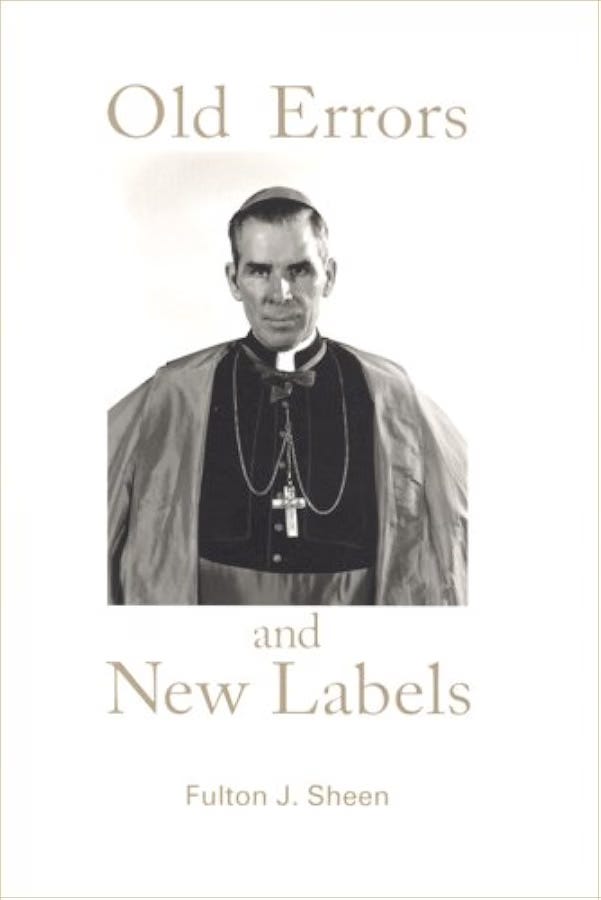
The saddest part of the performance is that Sheen possessed the intellectual equipment to do considerably better.
In 1931, he published Old Errors and New Labels, including the famous chapter A Plea for Intolerance.
There he defended the necessity of distinguishing truth from error and criticized the fashionable assumption that religious broad-mindedness was automatically virtuous.
He understood that Christian charity imposes no obligation to pretend that contradictory religious propositions are equally acceptable.
He even warned against the modern appetite for novelty.
Nearly four decades later, Buckley is sitting across from him asking what happened to Catholic doctrinal discipline.
And Sheen, the author of that earlier defense of doctrinal precision, explains that the Church has become more patient and kind.
The contrast is painful.
The Church’s obligation to correct error had somehow become entangled with a supposed rigidity that modern Catholics needed to outgrow.
The supernatural character of the Church was described in the language of monopoly.
The young wanted fewer restrictions, greater accommodation, and a more contemporary religious atmosphere. Their bishop assured them that the changes were coming, though perhaps more slowly than they wished.
Buckley, meanwhile, continued asking whether the Church could survive the loss of precisely those qualities that had once distinguished it.
The remarkable thing about this episode is the disparity between the men’s ecclesiastical positions.
Buckley possessed no episcopal authority. He was a lay Catholic and political commentator, hardly a flawless representative of traditional Catholic theology.
Sheen was an archbishop, a renowned philosopher, a participant in Vatican II, and one of the most gifted religious communicators in American history.
On questions concerning the Church’s doctrinal identity and the purpose of ecclesiastical discipline, however, the layman repeatedly displayed a firmer grasp of what was at stake.
The interview provides a particularly valuable historical document because it captures the postconciliar revolution in progress.
The collapse of traditional Catholic certainty was already visible. The liturgical experiments were underway. Episcopal discipline had become a subject of embarrassment. Young Catholics were being encouraged to regard inherited restrictions as obstacles to religious authenticity.
And the famous archbishop, confronted with these developments, seemed largely concerned with explaining why the Church needed to become more agreeable to the modern world.
Watching the interview today, one is struck by the ease with which the old language of conversion, authority, and doctrinal permanence gives way to adaptation, patience, community, and dialogue.
Sheen still possessed the voice, the anecdotes, and the formidable rhetorical gifts that had made him famous.
Buckley kept asking for the substance.
The tragedy of Firing Line was that, when the Church most needed its famous preacher to defend her inherited doctrine, he seemed increasingly prepared to explain why the modern world should be allowed to change the conversation.
Sources and Documentation
The original interview: Hoover Institution Library & Archives, Firing Line with William F. Buckley Jr., Episode 186, “Skepticism and Disorder,” recorded January 6, 1970. Watch the complete broadcast. Relevant exchanges include Vietnam and Communist aggression (approximately 2:00–23:45), Vatican II and the erosion of Catholic identity (24:00–31:00), heresy and excommunication (31:00–38:40), and the younger panelists’ questions concerning worship, tradition, and social change (41:00–52:30).
Canon law governing heresy: Codex Iuris Canonici (1917), Canon 1325 §2, defining heresy as the obstinate denial or doubt of a truth requiring divine and Catholic faith; and Canon 2314 §1, prescribing automatic excommunication for heresy, apostasy, and schism, subject to the applicable canonical conditions. Both provisions remained in force when Sheen appeared on Firing Line.
Sheen’s opposition to the Vietnam War: The Criterion, August 4, 1967, p. 8, “Withdrawal of Troops Urged by Bp. Sheen.” The contemporary report records Sheen’s public appeal for President Lyndon Johnson to withdraw American forces immediately from South Vietnam. Read the original newspaper.
The bishops of Vatican I: The Catholic World, vol. XI (1870), “The First Œcumenical Council of the Vatican,” No. Three. The contemporary account enumerates 83 council participants associated with Asian ecclesiastical jurisdictions and 14 with African jurisdictions, directly contradicting Sheen’s assertion that Vatican I had none. Read the historical account.
Sheen’s earlier defense of doctrinal intolerance: Fulton J. Sheen, Old Errors and New Labels (1931), chapter VII, “A Plea for Intolerance.” The chapter defends the distinction between religious truth and error and condemns the fashionable tolerance of contradictory doctrines. Read the reproduced excerpt.
Traditional Catholic teaching: Leo XIII, Immortale Dei (1885), on the Church and civil society; Pius XI, Quas Primas (1925), on Christ’s Social Kingship; Pius XI, Mortalium Animos (1928), on religious unity and doctrinal truth; Pius XI, Casti Connubii (1930), on Christian marriage and family obligations; and Pius XII, Mediator Dei (1947), on the nature of Catholic worship and the Holy Sacrifice of the Mass.
Vatican II and the liturgical reform: Second Vatican Council, Unitatis Redintegratio (1964), particularly §11 on false irenicism; and Yves Chiron, “How the Novus Ordo Mass Was Made,” Church Life Journal, University of Notre Dame, July 22, 2021, documenting the development of the postconciliar Mass.
"So let us be confident, let us not be unprepared, let us not be outflanked, let us be wise, vigilant, fighting against those who are trying to tear the faith out of our souls and morality out of our hearts, so that we may remain Catholics, remain united to the Blessed Virgin Mary, remain united to the Roman Catholic Church, remain faithful children of the Church."- Abp. Lefebvre